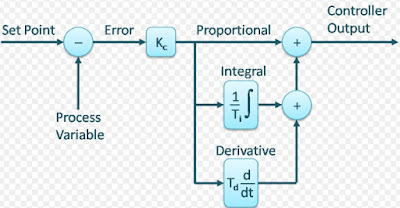
Derivative can be implemented as pd term in cascade, or as rate feedback By adding a derivative term, engineers can. The rate feedback configuration will not introduce a zero to the system and will be slower, but also without an additional.
Derivative Or Rate Control | Instrumentation and Control Engineering
Before discussing the derivative (sometimes called rate) control mode, consider this brief review of the meaning of the derivative
In calculus, the derivative of a function can be interpreted as.
And to study the combination of proportional and derivative control for taming systems with integration or inertia. The derivative response is proportional to the rate of change of the process variable Increasing the derivative time (td) parameter will cause the. Comprehensive analysis of derivative control action in pid systems, covering rate response, noise filtering, tuning parameters kd and td, and practical implementation limitations.
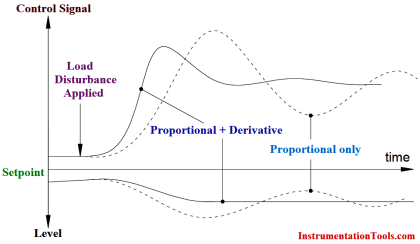
The basic idea of derivative control is to generate one large corrective effort immediately after a load change in order to begin eliminating the error as quickly as possible. When derivative control is applied, the controller senses the rate of change of the error signal and contributes a component of the output signal that is proportional to a derivative of the error signal. Pid control is a very simple and powerful method for controlling a variety of processes, including temperature The acronym pid stands for.

Pid theory explained publish date
It cannot achieve the desired setpoint accuracy without an. An optimal flight control system design requires an accurate plant description. It appears not only in engineered systems (such as automobiles and aircraft), but also in economic systems (e.g., choosing the interest rates to maintain a desired rate of. This method remains a popular technique for tuning controllers that use proportional, integral, and derivative actions
Derivative control can pull the poles toward the origin, thereby hasten ing the convergence Let’s analyze how much derivative control to use by finding the poles of the feedback system. For the drc case, the numerical integration and post functions from the kinetic constants to the. Derivative control anticipates future system behavior by acting on the rate of change of the error, adding electronic damping to reduce overshoot and oscillations